
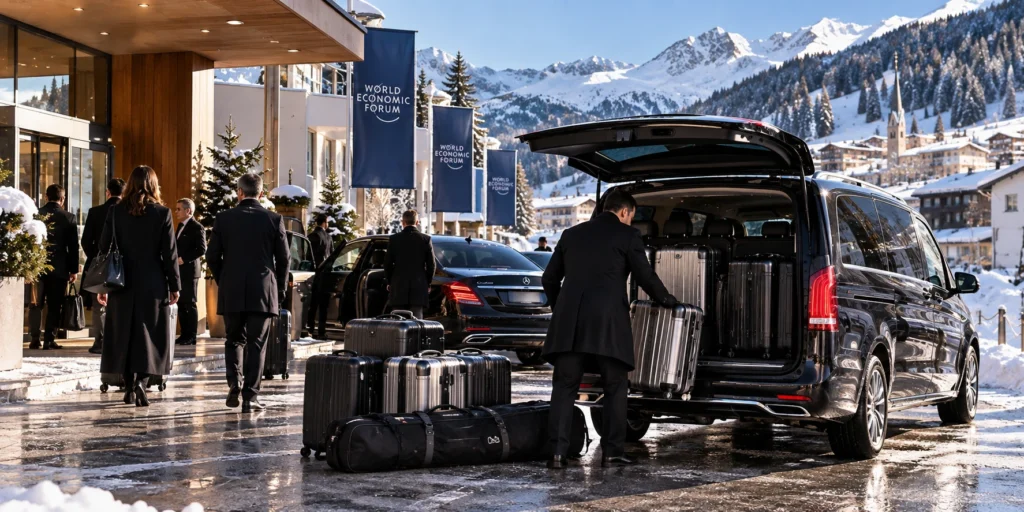
A WEF delegation can have only two or three passengers and still have the wrong vehicle plan.
The reason is simple:
passenger capacity and luggage capacity are two different transport problems.
A principal arriving with several large suitcases, garment bags and presentation cases may create a different requirement from four passengers travelling with cabin luggage. Add assistants, equipment, multiple aircraft or changing hotel schedules, and the luggage itself can become an independent ground movement.
For the World Economic Forum Annual Meeting 2027, scheduled in Davos from 18 to 22 January 2027, Executive Assistants, Family Offices and delegation coordinators should therefore decide whether passengers and luggage genuinely belong in the same vehicle plan before the arrival day.
This guide explains when a separate WEF luggage vehicle may make operational sense, when it probably does not, and which information should be reviewed before assigning the principal vehicle.
Passenger Capacity and Luggage Capacity Are Different Problems
Vehicle planning often begins with a question such as:
“How many passengers are travelling?”
That is necessary information, but it is not enough.
A proper WEF movement should consider at least four separate variables:
- number of passengers;
- actual luggage volume;
- type and size of unusual items;
- whether every person and every bag needs to reach the same destination at the same time.
This last question is particularly important.
The principal may need to leave immediately while an assistant is still waiting for another passenger. Staff may be checking into another hotel. Presentation equipment may need to go directly to an office or side-event location.
Once these movements separate, forcing everything into one vehicle can make the programme less efficient rather than simpler.
When Does a Separate Luggage Vehicle Make Sense?
A second vehicle should not be added merely because the programme is labelled VIP or WEF.
It should solve a real operational problem.
A separate luggage movement may be worth considering when:
- the principal has significantly more luggage than is practical for the preferred passenger vehicle;
- several passengers have large checked bags;
- garment bags, presentation cases or other bulky items are involved;
- principal and staff need different vehicles or destinations;
- luggage becomes available later than the passenger;
- several aircraft arrive at different times;
- bags need to move between hotels while the principal follows a meeting programme;
- departure-day luggage needs to leave independently of the passenger schedule.
In each case, the question is not:
“Can we add another car?”
It is:
“Does separating the luggage make the overall movement more reliable and easier to coordinate?”
When a Separate Vehicle Is Probably Unnecessary
More vehicles are not automatically better.
If the passengers, luggage and destination can be accommodated appropriately within one suitable vehicle assignment, adding another chauffeur introduces another driver, another handover and another movement to coordinate.
A separate vehicle may be unnecessary when:
- luggage volume is modest;
- everyone is travelling to the same destination;
- the assigned vehicle is appropriate for the real passenger and baggage requirement;
- there is no operational reason to separate principal, staff or bags;
- all luggage becomes available with the passengers.
The objective is therefore not to maximise the number of vehicles.
It is to use the minimum transport structure that still works reliably for the programme.
The Principal Vehicle Should Be Selected for the Principal Movement
A common planning mistake is selecting the principal vehicle by combining every requirement into one decision.
For example, an Executive Assistant may prefer a premium sedan for the principal but then change the entire passenger plan because additional luggage has to travel as well.
In some cases, those are better treated as two questions:
- Which vehicle is appropriate for the principal movement?
- How should the complete luggage requirement be transported?
Swiss Transfer Service’s passenger fleet includes Business Class, VIP Class and Mercedes V-Class options.
The right assignment depends on the actual passengers, luggage, route and programme rather than a universal suitcase number.
This is why luggage details should be provided before the vehicle is assigned.
S-Class or V-Class? Start with the Movement, Not the Vehicle Name
An S-Class-style VIP vehicle and a Mercedes V-Class serve different practical roles within a delegation programme.
Neither is automatically the correct choice simply because the client is attending WEF.
When a VIP sedan may suit the principal movement
A VIP-class vehicle may suit an executive or principal movement where premium passenger comfort, discretion and a relatively straightforward luggage requirement are priorities.
When a V-Class may suit the wider requirement
A Mercedes V-Class may be appropriate when the programme involves additional passengers, assistants or a larger luggage requirement.
The decision should still be based on the real load.
Avoid assuming that a particular model will always accommodate a fixed number of large cases because luggage dimensions vary significantly.
When two movements may work better than one
If the preferred principal vehicle remains appropriate for the passenger but not for the complete delegation baggage requirement, a second vehicle can be assessed separately.
This allows the passenger vehicle and luggage movement to be designed for their actual purposes.
Private Jet Arrivals Make Luggage Planning More Important
Private aviation does not remove the luggage question.
In some programmes, it makes the sequencing more important.
A principal may arrive through Zurich Airport’s General Aviation Center with assistants, checked bags and equipment while another delegation member arrives on a separate aircraft.
The road team then needs to understand which passenger and which luggage belong to each movement.
The coordinator should establish:
- which aircraft carries the principal;
- which aircraft carries assistants or staff;
- where the relevant luggage is located;
- whether every bag becomes available with the principal;
- which items need to reach the principal’s hotel;
- whether another destination is involved.
For private aviation arrivals at Zurich, our Zurich Airport GAC to Davos guide for WEF 2027 explains the passenger handover between the aviation and chauffeur sides in more detail.
The Passenger May Be Ready Before the Luggage
One important scenario occurs when the principal is ready to begin the road journey but the complete luggage requirement is not yet ready to move.
Waiting may be sensible in some situations.
In others, holding the principal solely because additional bags or staff items are still being coordinated may conflict with the rest of the programme.
The Executive Assistant should decide whether:
- the principal waits and everything departs together;
- the principal departs while another movement follows;
- an assistant remains responsible for the luggage;
- the luggage is delivered to another hotel or destination.
The chauffeur team should not make this hierarchy decision independently.
It should receive a clear transport instruction from the person coordinating the delegation.
What If the Private Jet Is Diverted?
A diversion can change the luggage plan as well as the passenger pickup.
If an aircraft expected in Zurich instead arrives at Altenrhein, Friedrichshafen or another airport, the road team should not assume that the original passenger and baggage arrangement remains valid.
The revised plan should confirm:
- which passengers arrived at the new airport;
- which luggage arrived with them;
- whether another aircraft still carries part of the delegation;
- where the original chauffeur is positioned;
- whether another vehicle is better placed for the new movement.
Our WEF 2027 private jet diversion ground-transport guide covers how an airport change affects the complete road programme.
What If a Helicopter Plan Changes to Road Transport?
Luggage can become particularly important when a planned air movement is replaced by a road movement.
The aviation and road plans may have been built around different baggage assumptions.
When the road contingency becomes active, the transport coordinator should reconfirm exactly which passengers and items now need to travel by road.
Do not assume that:
- all luggage was part of the original helicopter movement;
- all luggage is physically with the principal;
- the backup passenger vehicle is appropriate for the complete luggage requirement;
- staff and principal must travel together.
For the wider contingency process, read our Zurich–Davos road backup guide for WEF 2027.
Multiple Aircraft Can Create Multiple Luggage Streams
A delegation arriving on several aircraft should not automatically be treated as one airport pickup.
Consider this simplified example:
- Aircraft A carries the CEO and personal luggage;
- Aircraft B carries the CFO, EA and additional bags;
- Aircraft C carries staff and presentation material.
Even if everyone ultimately stays in Davos, the correct ground movement may be different for each arrival.
Questions for the coordinator include:
- Does the principal leave immediately?
- Should executives consolidate before departure?
- Does luggage follow the passenger or the hotel destination?
- Does staff equipment need to reach an office rather than a hotel?
- Who confirms that every bag has been assigned to the correct movement?
This is where luggage planning becomes part of wider WEF delegation transportation rather than an isolated airport-transfer issue.
Staff and Principal Luggage Should Not Be Treated as One Category
Not every item has the same priority or destination.
It can be useful to distinguish between:
- principal personal luggage;
- assistant luggage;
- staff luggage;
- presentation material;
- media or production equipment;
- items required immediately for meetings;
- items that only need to reach the hotel.
This prevents an important briefcase or garment bag from being treated operationally the same as luggage that can arrive later.
The transport team does not need unnecessary detail about personal belongings.
It does need to know which items have different destination or timing requirements.
Hotel Check-In Can Create a Separate Luggage Movement
WEF schedules do not always align neatly with hotel check-in or the principal’s first meeting.
A passenger may arrive in the region and need to continue toward a meeting, office or hospitality location before spending meaningful time at the hotel.
In such a programme, the coordinator should decide whether luggage:
- stays with the principal;
- continues directly to the hotel;
- remains with an assistant;
- moves later after the room or receiving contact is ready.
The hotel should be aware of the planned handover where required.
A chauffeur should not simply leave luggage at an unconfirmed location.
Hotel Changes During WEF Need Their Own Luggage Plan
A mid-programme hotel or accommodation change creates another scenario in which the passenger and luggage do not necessarily need to move together.
The principal may have meetings throughout the day while luggage needs to move from one property to another.
Combining both movements may force unnecessary schedule changes.
Before arranging a separate luggage movement, confirm:
- the collection property;
- the receiving property;
- who releases the luggage;
- who accepts it at the destination;
- which items must remain with the principal;
- whether current local vehicle-access conditions affect either property.
Presentation Cases and Equipment Need to Be Declared Before Vehicle Assignment
“Six bags” is not enough information if two of those items are unusually large equipment cases.
The same applies to:
- large presentation cases;
- production equipment;
- display material;
- oversized garment luggage;
- specialist business equipment.
The coordinator does not need to provide an exhaustive packing inventory.
Approximate dimensions or a clear description of unusual items can prevent the wrong vehicle from being assigned.
Friday Departure Can Reverse the Arrival Problem
Luggage planning matters on departure as much as arrival.
The principal may have a final meeting while luggage is already ready at the hotel.
Assistants may leave at a different time.
Different passengers may be departing from different airports.
A departure plan should therefore establish:
- which airport each traveller is using;
- when the principal must leave Davos;
- when luggage becomes available for collection;
- whether all bags are travelling with the same passenger;
- whether staff have separate departure movements;
- who performs the final luggage reconciliation.
If the passenger and luggage are separated, one coordinator should know exactly which items belong to each onward journey.
Davos Access Can Affect the Final Luggage Handover
The World Economic Forum Annual Meeting 2027 is officially scheduled for
18–22 January 2027 at the Davos Congress Centre.
Current event information is available from Destination Davos Klosters.
Previous WEF editions have included temporary traffic restrictions, controlled areas and security procedures in Davos.
The detailed 2027 operating rules should be checked when the current official information is published rather than assuming a previous year’s access arrangements still apply.
This matters for luggage because the receiving point may not always be identical to the assumed hotel entrance or meeting location.
For each separate luggage movement, confirm:
- the exact delivery location;
- a receiving contact;
- current vehicle-access instructions;
- what happens if the planned vehicle approach is unavailable.
One Vehicle vs Two Vehicles: A Practical Decision Framework
| Question | One Vehicle May Be Enough When… | Separate Movement May Help When… |
|---|---|---|
| Passengers | Everyone travels together. | Principal, staff or assistants have different schedules. |
| Luggage | The real luggage load suits the assigned vehicle. | Luggage materially changes the preferred passenger vehicle. |
| Timing | Passenger and bags are ready together. | The principal needs to depart before all luggage is ready. |
| Destination | Everything goes to the same address. | Passengers, staff or equipment have different destinations. |
| Aircraft | Everyone arrives on one movement. | Several aircraft create separate passenger or luggage streams. |
| Programme | The arrival is simple and linear. | The delegation immediately splits into different WEF movements. |
This framework is more useful than choosing the vehicle from a generic luggage-capacity chart.
Information to Send Before We Assign the Vehicles
For a WEF delegation with significant luggage, provide the following information before final vehicle assignment.
Passengers
- number of principals;
- assistants and staff travelling with them;
- whether the group remains together after arrival.
Luggage
- approximate number of bags;
- large suitcases;
- garment bags;
- unusually large cases;
- business or presentation equipment.
Arrival
- arrival airport;
- commercial terminal or private aviation arrival;
- flight information;
- FBO or handler where relevant;
- whether several aircraft are involved.
Destinations
- principal’s exact destination;
- staff hotel where different;
- luggage delivery location;
- local receiving contact.
Programme
- whether the principal must leave immediately;
- whether staff remain at the airport;
- whether luggage may follow later;
- who can approve an additional vehicle.
Common WEF Luggage Planning Mistakes
Choosing the vehicle from passenger count alone
Two passengers with significant luggage can require a different plan from four passengers with light bags.
Using a fixed suitcase number from a generic vehicle specification
Real luggage varies in size and shape.
Vehicle suitability should be reviewed from the actual requirement.
Changing the principal vehicle just to accommodate staff luggage
In some programmes, it may be more logical to separate the movements.
Assuming every bag is released with the principal
Private aviation, multiple flights and staff movements can create different luggage timelines.
Not identifying oversized equipment
One large case can materially change an otherwise straightforward vehicle assignment.
Sending luggage to a hotel without a receiving plan
Confirm the property, receiving contact and handover before creating an independent luggage movement.
Forgetting the departure-day luggage sequence
The same problem can reappear when the principal has final meetings before leaving Davos.
A Separate Luggage Vehicle Is an Operational Tool, Not a Luxury Add-On
The purpose of an additional vehicle is not to make the delegation appear larger or more premium.
It should solve a clear problem such as:
- protecting the principal schedule;
- keeping staff movements independent;
- handling a larger real-world luggage requirement;
- serving a different destination;
- supporting several aircraft or arrival times;
- separating hotel delivery from the executive programme.
If it solves none of those problems, it may not be necessary.
Plan WEF 2027 Delegation Transport with Swiss Transfer Service
If you are arranging ground transportation for WEF 2027, send Swiss Transfer Service the actual passenger and luggage requirement rather than selecting a vehicle category from passenger count alone.
Include the arrival airport, flight or private aviation information, passenger split, approximate luggage, unusual cases and exact Davos destinations.
We can then assess whether the programme is better handled with one suitable passenger vehicle or multiple coordinated ground movements.
For programmes involving several executives, vehicles, arrivals and daily meeting movements, see our WEF delegation transportation in Davos.
WEF 2027 Luggage Vehicle FAQ
Does every WEF delegation need a separate luggage vehicle?
No. A separate vehicle is useful only when the real passenger, luggage, timing or destination requirements justify another movement. If one suitable vehicle can handle the complete requirement appropriately, adding another vehicle may create unnecessary coordination.
How do I know whether our luggage will fit in the principal vehicle?
Provide the actual passenger count, approximate bag count and details of unusually large luggage or equipment before vehicle assignment. Avoid relying solely on generic suitcase-capacity figures because real luggage dimensions vary.
Should we choose an S-Class or V-Class for WEF luggage?
Start with the complete movement rather than the model name. A VIP-class sedan may suit a principal movement with a straightforward luggage requirement, while a Mercedes V-Class may be more appropriate for additional passengers or a larger load. In some cases, separating the passenger and luggage movements may be more practical.
Can the principal leave Zurich while another vehicle waits for luggage?
Where the programme and actual luggage situation justify it, passenger and luggage movements can be assessed separately. The Executive Assistant or delegation coordinator should decide who remains responsible for the luggage and where it should be delivered.
What happens to luggage if a private jet is diverted?
Reconfirm which passengers and bags have arrived at the revised airport before assigning the road vehicles. A diversion may change the passenger handover, luggage timing and vehicle positioning as well as the airport itself.
Can luggage be delivered directly to a Davos hotel?
A separate hotel delivery can be considered where appropriate, but the receiving property, contact person and current access instructions should be confirmed before the movement. Luggage should not simply be left at an unconfirmed location.
Can staff and principal luggage travel separately?
Yes, where the programme requires different passenger, staff or luggage movements. The coordinator should clearly identify which items belong to each destination and who is responsible for the handover.
Should departure luggage be planned separately too?
Yes. If the principal has meetings before departure, staff are leaving at different times or travellers are using different airports, the luggage sequence should be confirmed in advance rather than reconstructed on departure day.