
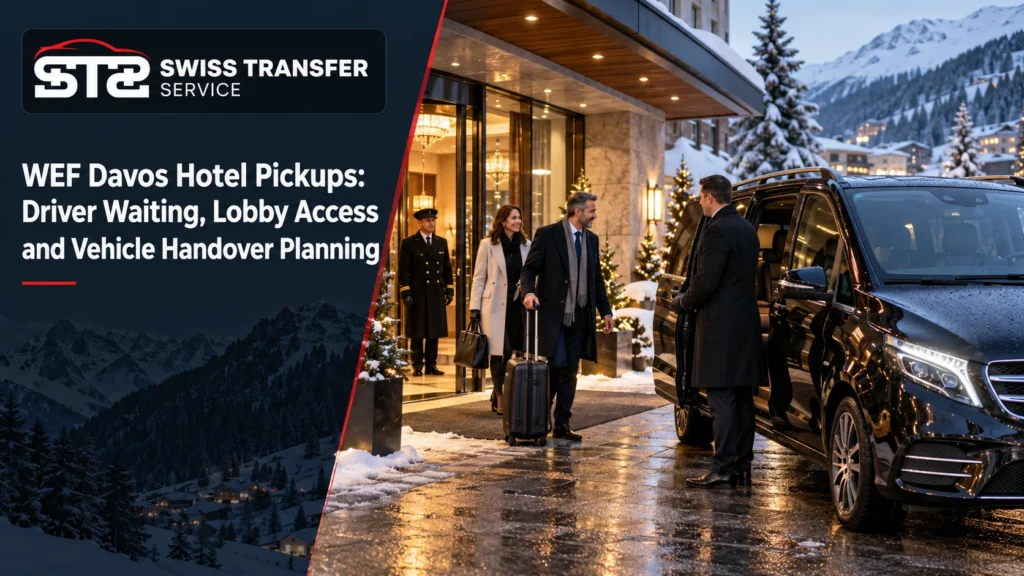
A WEF Davos hotel pickup can look simple on an itinerary:
07:45 — chauffeur waiting at hotel.
Operationally, that instruction may be incomplete.
During the World Economic Forum Annual Meeting, the hotel may sit inside or close to a controlled security area, stopping and parking options may change, the vehicle may not be able to remain directly outside the entrance, and the principal may need a clearly defined handover rather than simply “meeting the driver in the lobby”.
For WEF 2027, scheduled in Davos from 18 to 22 January 2027, Executive Assistants, Family Offices and delegation coordinators should define three separate things for every important hotel movement:
- where the passenger will be collected;
- where the vehicle can legally and operationally wait;
- what happens if the planned pickup point cannot be used.
This guide explains how to structure a WEF Davos hotel pickup without assuming that previous-year security zones, vehicle permissions or hotel procedures will automatically apply in 2027.
A Hotel Name Is Not a Complete Pickup Instruction
“Pick up from Hotel X” may be enough for an ordinary journey.
During WEF week, it is better to define the movement more precisely.
A complete pickup instruction may need:
- the hotel or property name;
- the exact entrance or agreed handover point;
- the passenger or Executive Assistant contact;
- the chauffeur contact;
- the scheduled movement time;
- the vehicle-access instruction currently in force;
- a fallback pickup point where appropriate.
The purpose is not to make a simple movement complicated.
It is to remove ambiguity before the principal is standing outside a secured hotel while the driver is waiting somewhere else.
Previous WEF Editions Show Why Hotel Access Must Be Rechecked
Official information from the Canton of Graubünden for WEF 2026 documented security zones around several high-traffic locations in Davos, including the Congress Center and adjacent hotel area, the Belvédère, the AlpenGold, the ice stadium and the Lago heliport area.
The same official information also stated that precautionary checks of people, vehicles and baggage were carried out on access roads into Davos and that delays could occur.
The Canton of Graubünden’s official WEF information publishes the annual security-zone, traffic and authority documents when they become available.
These previous rules are useful for planning because they demonstrate that WEF access is dynamic.
They are not confirmation of the exact WEF 2027 hotel-access rules.
The 2027 plan should therefore be updated when the current authority documents and hotel instructions are published.
Security-Zone Access and Hotel Access Are Related but Not Identical
A useful planning distinction is:
reaching the hotel area, reaching the vehicle stopping point and entering the hotel itself are three different questions.
A security-zone vehicle authorisation may affect how close the car can get.
A hotel may have its own arrival or concierge instructions.
A passenger or chauffeur credential may affect access to a controlled area.
These should not be compressed into one assumption such as:
“The car has a sticker, so the driver can go anywhere.”
Instead, confirm the specific movement:
- Can the vehicle enter the relevant area?
- Where may it stop or wait?
- Where should the principal meet the chauffeur?
Can the Chauffeur Wait Directly Outside the Hotel?
Sometimes the practical answer may be yes.
In other locations or at certain times, traffic controls, security measures, congestion or hotel instructions may require a different waiting arrangement.
Official WEF traffic orders from previous editions have included road closures, parking restrictions, controlled stopping areas and temporary changes affecting central Davos.
For example, the official 2026 traffic order included temporary closures and restrictions affecting roads around the Congress Centre and other central areas.
That means the chauffeur plan should distinguish between:
- pickup point — where the principal enters the vehicle;
- waiting position — where the chauffeur remains before the passenger is ready;
- fallback point — where both sides move if the planned pickup is unavailable.
Those three places can be identical, but they do not have to be.
Do Not Confuse “Waiting” with “Parking”
This distinction becomes important during a high-demand event.
A vehicle that can briefly collect a passenger at a particular point may not necessarily be permitted to remain there for an extended period.
The chauffeur team therefore needs to know whether the requirement is:
- arrive shortly before the principal is ready;
- remain on standby nearby;
- wait through an uncertain meeting end time;
- return to the hotel when called;
- move to another authorised waiting location.
This is particularly relevant for meetings with unpredictable finish times.
Writing “driver waits at entrance from 14:00” may create an impractical instruction if the location cannot support extended waiting.
Lobby Access Should Be Confirmed, Not Assumed
It is tempting to write a universal rule such as:
“WEF chauffeurs cannot enter hotel lobbies.”
That should not be treated as a general WEF fact unless the current hotel, security or accreditation instructions specifically support it.
The public authority documents confirm restricted areas and vehicle controls, but they do not establish one universal lobby rule for every chauffeur at every Davos hotel.
The better operational approach is to confirm:
- whether the chauffeur should remain with the vehicle;
- whether the hotel concierge will notify the principal;
- whether the Executive Assistant escorts the passenger to the car;
- whether a security or protocol officer handles the handover;
- whether the driver is expected at a specific entrance rather than inside the property.
The itinerary should describe the arrangement actually confirmed for that hotel and delegation.
The Principal Handover Should Have One Clear Owner
A common WEF coordination problem occurs when everybody assumes somebody else is managing the last 30 metres.
The chauffeur believes the Executive Assistant will bring the principal outside.
The EA believes the driver will come into the hotel.
The principal walks to the main entrance.
The driver has been instructed to use a side entrance.
A better plan assigns responsibility.
For example:
- hotel concierge calls the chauffeur when the principal leaves the room;
- EA confirms “principal moving” in the transport group;
- chauffeur moves from waiting position to pickup point;
- principal meets vehicle at the agreed entrance.
The exact method can vary.
The important thing is that the handover is designed rather than assumed.
Use “Principal Moving” Instead of Guessing the Meeting End Time
WEF schedules are not always precise enough for a chauffeur to rely only on the calendar.
A meeting listed as ending at 16:00 may end earlier, continue longer or turn into another conversation.
For movements where the vehicle cannot remain indefinitely at the pickup point, a useful operating sequence is:
- chauffeur remains at the agreed waiting position;
- EA or coordinator sends a “principal moving” update;
- chauffeur approaches the confirmed pickup point;
- passenger handover occurs;
- vehicle continues to the next movement.
This reduces unnecessary vehicle movement and avoids relying on an exact meeting finish time that the transport team does not control.
Hotel Pickup Timing Should Include the Passenger Handover
“Departure at 08:00” can mean different things.
Does it mean:
- principal leaves the room at 08:00;
- principal reaches the lobby at 08:00;
- principal enters the car at 08:00;
- vehicle should already be moving at 08:00?
For a tightly scheduled WEF programme, define the milestone.
A useful itinerary might separate:
- 07:50 — chauffeur ready / waiting position confirmed
- 07:55 — principal moving
- 08:00 — vehicle departure target
These are planning instructions, not guarantees.
Their value is that the transport team and Executive Assistant are using the same definition of departure.
What If the Planned Hotel Entrance Becomes Unavailable?
Every high-priority movement should have a simple fallback.
The fallback does not need to be another hotel or a complicated route.
It may simply be another authorised nearby handover point that both the chauffeur and coordinator understand.
The fallback becomes useful when:
- security temporarily changes the vehicle approach;
- traffic congestion blocks the preferred entrance;
- a meeting moves to another part of the property;
- the hotel gives an updated vehicle instruction;
- the principal exits through a different door.
The chauffeur should not improvise a restricted pickup point.
The coordinator should confirm the revised handover when required.
Secure Hotels Need More Precise Instructions, Not More Assumptions
Previous WEF security-zone documentation has specifically included areas around properties such as the Belvédère and AlpenGold, along with the Congress Centre and nearby hotel area.
That historical pattern makes these locations worth planning carefully.
It does not mean a 2026 vehicle credential or approach automatically defines WEF 2027 access.
For a high-security hotel movement, the transport brief should include:
- current access credential information supplied to the delegation;
- hotel arrival or pickup instruction;
- principal or EA mobile contact;
- chauffeur contact;
- preferred entrance;
- fallback handover;
- next destination.
This makes the hotel pickup a controlled movement instead of a driver searching for the passenger inside a changing security environment.
What About Hotels Outside the Main Security Zones?
Not every Davos hotel operates inside the same security perimeter.
Official 2026 authority information stated that while designated areas had restricted access, other hotels and businesses remained generally accessible.
Even so, “outside the security zone” does not mean:
- there will be no congestion;
- the driver can park anywhere;
- meeting end times will be predictable;
- the entrance will always remain the best pickup point.
The same pickup discipline is still useful:
agreed point, current contact, waiting logic and fallback.
Hotel Pickup and Congress Centre Drop-Off Are Different Movements
A driver being able to collect a principal from a hotel does not automatically mean the same vehicle can drive directly to every WEF destination.
The onward movement may involve:
- a controlled road;
- a security-zone boundary;
- an authorised vehicle approach;
- a final walking segment;
- a different passenger handover.
The transport plan should therefore define the destination handover separately from the hotel pickup.
This becomes especially important for meetings around the Congress Centre, Promenade and other high-traffic WEF locations.
Do Not Build the Daily Programme Around One Permanent Hotel Waiting Spot
A full-day chauffeur programme should not assume that the vehicle can remain directly outside the principal’s hotel between every movement.
A more resilient model is:
- pickup point defined;
- nearby waiting logic defined;
- chauffeur remains reachable;
- EA provides movement updates;
- vehicle approaches when required.
This is particularly useful when the itinerary contains several movements between a hotel, side events, private residences and meeting locations.
For the wider daily operating model, see our WEF 2027 executive ground transport planning guide.
Multiple Principals Create Multiple Hotel Handover Problems
A delegation with several executives should not assume that one hotel and one driver equal one movement.
Consider a programme where:
- the CEO leaves the hotel for the Congress Centre;
- the CFO remains in a meeting at the same property;
- an assistant needs to travel to another venue;
- a second principal is returning from Zurich.
The hotel may now be both a pickup point and a future return point for several independent movements.
The coordinator should identify:
- which vehicle belongs to which principal;
- which chauffeur is waiting versus moving;
- who receives each “principal moving” update;
- where each passenger is expected to meet the vehicle.
For multi-vehicle programmes, see our WEF delegation transportation in Davos.
Luggage Can Change the Hotel Handover
A hotel movement is not always just a passenger pickup.
The principal may be leaving for Zurich while luggage is still being brought down.
An assistant may be moving bags between hotels.
Staff luggage may be leaving on another vehicle.
The coordinator should confirm whether:
- all luggage moves with the principal;
- bags need an earlier hotel collection;
- a separate luggage vehicle is involved;
- the hotel concierge has the luggage ready;
- another person is responsible for the bag handover.
For programmes where luggage becomes its own movement, read our WEF 2027 separate luggage vehicle guide.
A Hotel Pickup Can Change After an Airport Diversion
Private aviation changes can also affect hotel movements later in the day.
If a principal expected from Zurich instead arrives through Altenrhein or Friedrichshafen, the hotel arrival time may change significantly.
The planned waiting chauffeur may no longer need to be at the property at the original time.
The coordinator should update:
- hotel ETA;
- next meeting departure;
- vehicle assignments;
- staff movements;
- luggage delivery;
- concierge or receiving contact.
Our WEF private jet diversion guide covers how airport changes affect the wider ground programme.
Hotel Pickup Checklist for Executive Assistants
Property
- Confirm the exact hotel or residence.
- Confirm the intended entrance.
- Record the concierge or local contact where useful.
- Check current WEF access instructions.
Passenger
- Identify the principal.
- Identify the EA or movement coordinator.
- Confirm a working mobile contact.
- Confirm whether assistants travel with the principal.
Vehicle
- Confirm assigned chauffeur.
- Confirm current vehicle access.
- Define the pickup point.
- Define the waiting logic.
- Define a fallback point where required.
Timing
- Distinguish chauffeur-ready time from passenger departure time.
- Use a “principal moving” update when meeting times are uncertain.
- Tell the chauffeur when the movement is materially delayed.
Destination
- Provide the exact next address.
- Confirm any known destination access instruction.
- Identify a final walking or handover segment where relevant.
Common WEF Hotel Pickup Mistakes
Writing only the hotel name
The driver still needs to know where the actual handover will occur.
Assuming the chauffeur can remain at the entrance indefinitely
A pickup point may not be an appropriate long-term waiting position.
Assuming a vehicle credential solves every access question
Vehicle access, stopping location and passenger handover are different issues.
Treating lobby access as a universal rule
Confirm the hotel and current security instruction rather than relying on a generic claim that all WEF drivers can or cannot enter lobbies.
Not defining who brings the principal to the vehicle
The last metres of the movement should have a clear owner.
Using meeting end time as an exact pickup time
Use operational updates when the real passenger movement is uncertain.
Using last year’s security map as the current rule
Previous WEF security zones are planning evidence, not confirmation of 2027 permissions.
WEF 2027 Hotel Pickup Planning with Swiss Transfer Service
For a Davos hotel pickup during WEF 2027, send Swiss Transfer Service the hotel, principal name or operational reference, requested movement time, next destination and any current hotel or delegation access instructions.
For complex programmes, also include:
- the assigned Executive Assistant or transport coordinator;
- multiple principal movements;
- luggage requirements;
- expected waiting requirements;
- known security or protocol instructions.
This allows the chauffeur movement to be planned around the actual handover instead of relying on “driver outside hotel” as the complete operating instruction.
WEF Davos Hotel Pickup FAQ
Can a chauffeur wait directly outside a Davos hotel during WEF?
It depends on the location, current traffic restrictions, security arrangements and hotel instructions. The pickup point and longer-term waiting position should be confirmed separately rather than assuming the vehicle can remain at the entrance indefinitely.
Can the driver enter the hotel lobby to collect the principal?
There is no single public WEF rule that should be assumed for every hotel and chauffeur. Lobby or property access should be confirmed from the current hotel, security and credential arrangements for the specific movement.
Are some Davos hotels inside WEF security zones?
Previous official WEF editions have included restricted security zones around locations such as the Congress Centre and nearby hotel area, the Belvédère and AlpenGold. The exact WEF 2027 zones and access rules should be checked once the current official documents are published.
What is the difference between a hotel pickup point and a waiting point?
The pickup point is where the principal enters the vehicle. The waiting point is where the chauffeur remains before the passenger is ready. They may be the same location, but WEF traffic or security conditions can make separate locations more practical.
What should we do if the hotel entrance cannot be reached?
Use the confirmed fallback handover agreed by the coordinator and chauffeur team. The driver should not independently improvise an unauthorised pickup point inside a controlled area.
How should an EA coordinate an uncertain meeting finish time?
Keep the chauffeur at the agreed waiting position and send a movement update when the principal is actually preparing to leave. This can be more reliable than treating the calendar meeting end time as the exact vehicle pickup time.
Does a hotel vehicle sticker or credential guarantee access to every WEF destination?
No universal assumption should be made. Hotel-area vehicle access and access to another controlled WEF destination are separate questions and should be confirmed using the current 2027 instructions.
What information should I send when arranging a WEF hotel pickup?
Provide the hotel or property, preferred entrance where known, movement time, principal or operational reference, coordinator contact, next destination, luggage requirements and any current hotel, security or protocol instructions.