
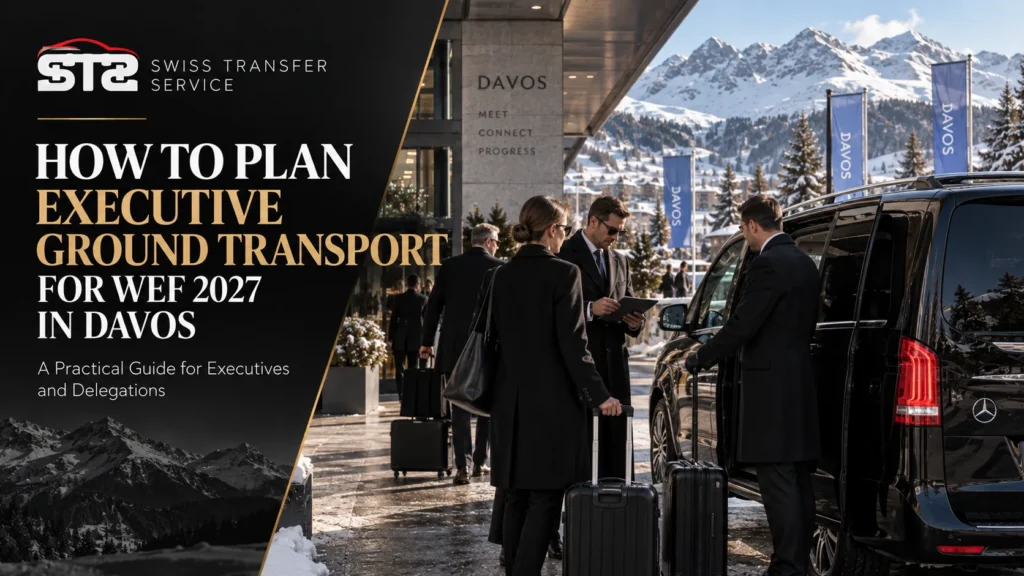
Transport planning for the World Economic Forum in Davos is very different from booking
a single airport transfer.
For an Executive Assistant, Personal Assistant, Corporate Travel Manager or delegation
coordinator, the real challenge begins after the principal has reached Davos.
A typical day may involve:
hotel → breakfast meeting → Congress Centre → bilateral meeting → lunch → side event
→ hotel → dinner → evening reception → hotel
Times move. Meetings overrun. Dinner addresses change. Two executives who travelled
together in the morning may need different vehicles an hour later. Security arrangements
can affect where a chauffeur may wait or where the final vehicle handover takes place.
The correct planning unit is therefore not simply a car booking.
It is a daily movement programme.
The World Economic Forum Annual Meeting 2027 is currently listed for
18–22 January 2027 in Davos. As of 13 September 2026, however, the
detailed 2027 traffic order, security-zone map, vehicle-access procedures and official
waiting arrangements have not yet been published.
This guide explains how to build a transport programme that can still function when
those details — and the executive diary itself — change.
WEF Transport Is a Moving Schedule, Not a Series of Transfers
A simple transfer has a clear structure:
pickup → journey → destination.
A WEF executive day rarely behaves that way.
The end of one meeting determines the start of the next movement. A driver may need to
reposition instead of waiting. A principal may decide to walk. An assistant may receive
a new dinner location while another executive needs a vehicle immediately.
That means transport should be built around:
- individual movements;
- time buffers;
- confirmed versus provisional appointments;
- vehicle availability;
- legal waiting possibilities;
- walking segments;
- one clearly defined change authority.
The goal is not to predict every change.
The goal is to build a system that can absorb changes without creating contradictory
instructions.
Start with the Daily Movement Programme
A WEF itinerary should not be only a list of meeting times.
Each transport movement needs enough operational information for the assistant,
chauffeur and transport coordinator to understand what happens before and after it.
What every movement should contain
| Field | Why it matters |
|---|---|
| Date and version | Identifies which programme is current |
| Passenger / principal | Shows exactly who is travelling on that movement |
| Status | Confirmed, provisional or cancelled |
| Pickup location | Hotel or venue name plus exact entrance where known |
| Pickup time | The time the vehicle is expected |
| Meeting start time | Allows the movement to be planned backward from the actual commitment |
| Destination | Venue plus entrance, porch or agreed handover point |
| Access note | Restricted area, possible walking segment or loading instructions |
| Host contact | Useful if the entrance or temporary event location is unclear |
| EA / coordinator | Primary operational contact |
| Wait / release instruction | Tells the chauffeur whether to remain assigned, reposition or leave |
| Luggage | Clarifies whether bags or equipment are travelling |
| Next movement | Prevents one movement from making the next impossible |
| Change authority | Defines who may alter the programme |
Confirmed vs provisional movements
This distinction is essential during WEF.
A dinner that is expected but has no confirmed address should not appear in the same way
as a 09:00 board meeting with a fixed location.
Use clear labels:
- CONFIRMED — time and location are operationally usable;
- PROVISIONAL — expected, but details can still change;
- CANCELLED — remains visible so nobody follows an obsolete version.
This makes a changing programme easier to control without pretending every line of the
diary is final.
One Chauffeur or Multiple Vehicles?
Vehicle planning should follow the schedule rather than a simple passenger count.
There is no useful rule such as “one vehicle for every three executives”.
One principal
One dedicated vehicle may be sufficient when the principal and assistant move together,
appointments are sequential and there are no overlapping logistics requirements.
The important questions are:
- Can the vehicle legally wait between movements?
- If not, where will it reposition?
- How quickly can it realistically return?
- Does luggage or equipment need to move separately?
Multiple executives
Two executives travelling together at breakfast do not necessarily need to remain one
transport unit for the rest of the day.
If Executive A has a 09:00 meeting at one location and Executive B has a 09:15 meeting
elsewhere, the programme has simultaneous vehicle demand.
That is a scheduling problem, not a vehicle-capacity problem.
Delegations with overlapping schedules
For a delegation, group passengers by schedule cluster.
Executives with the same movements can travel together. Executives whose diaries diverge
need operational independence even if they belong to the same company and invoice.
A useful planning test is:
“Will any two principals need to be in different places at approximately the same time?”
If the answer is yes, a single vehicle may become the main operational weakness of the
programme.
Give One Person Control of Transport Communication
Multiple people giving instructions to one chauffeur is one of the easiest ways to lose
control of a WEF schedule.
A principal texts the driver.
An assistant changes the destination.
A colleague asks the chauffeur to collect another passenger.
A local host sends a different entrance.
All four instructions may be individually reasonable and collectively impossible.
The EA as operational contact
The cleanest structure is to nominate one transport coordinator or EA as the
change authority.
Other passengers may communicate with the chauffeur when necessary, but material schedule
changes should return to the named coordinator.
Use one primary channel
Agree the operating channel before the week begins.
It may be WhatsApp, Signal, telephone or another agreed method. The important principle is
consistency.
Avoid maintaining:
- one itinerary in email;
- a second version in a WhatsApp group;
- driver instructions in private messages;
- another version on the principal’s phone.
How to communicate a change
A transport change should contain the new operational information, not a long explanation.
CHANGE v3.3
Movement: M3
New pickup: 13:05
New destination: [venue + entrance]
Previous destination: CANCELLED
Passenger: [name]
Wait instruction: RELEASE
Please confirm ETA.
A message such as “meeting is running a little late” is much less useful than:
M2 +20 MINUTES
New estimated release: 11:50
Please hold current assignment.
Build Version Control into the Itinerary
During WEF, the schedule itself becomes an operational document.
Programme v1 may be emailed on Monday.
Programme v2 may be sent as a screenshot.
Programme v3 may contain a new dinner.
Programme v4 may be on the assistant’s phone but never reach the driver.
Avoid this by using one master itinerary.
A simple naming structure is enough:
WEF2027_[PRINCIPAL]_19JAN_v4_0740
The header should show:
- date;
- version number;
- time issued;
- programme owner.
Every operational change should either update that version or be clearly identified as a
live amendment to a specific movement.
Drivers should normally receive the relevant day programme rather than the entire
confidential week schedule.
Hotel-to-Meeting Transport During WEF
“Hotel to Congress Centre” is not enough information for a WEF movement.
Use the exact entrance, not only the address
Temporary venues, hotel porches, garages, side entrances and loading areas can be
operationally different locations.
A useful destination record contains:
- venue name;
- street address;
- entrance or porch;
- host contact;
- known access note;
- fallback handover point where appropriate.
Security zones and walking segments
Previous WEF editions have involved temporary security zones, traffic restrictions,
controlled approaches and changes to vehicle access.
These historical arrangements demonstrate why a WEF transport programme needs flexibility.
They do not establish the rules for January 2027.
As of 13 September 2026, the detailed 2027 traffic order, vehicle-access regime and security
map have not yet been published.
Coordinators should monitor the official Canton of Graubünden WEF information and Gemeinde Davos WEF information closer to the event.
Why door-to-door access cannot always be assumed
A chauffeur schedule should never depend on the assumption that the vehicle can remain
directly outside every venue.
A more resilient plan is:
vehicle → nearest lawful handover point → walking / security segment → venue
The exact handover point should be confirmed using the current 2027 rules when those rules
are published.
Walking Should Be Part of the Transport Plan
Chauffeur planning does not end when the passenger leaves the vehicle.
The final segment may involve:
- walking from an authorised drop-off;
- badge or security screening;
- finding a temporary pavilion entrance;
- crossing snow or slush;
- carrying a laptop, coat or documents.
Do not invent a fixed walking-time allowance for every venue.
Instead, add an explicit final-segment buffer where access is uncertain.
If the principal decides to walk to the next meeting, update the chauffeur programme as
well. The vehicle may need to be released or repositioned rather than remaining at the
original location.
Separate Luggage from the Daily Programme
Arrival luggage and daily executive transport are different operational problems.
A vehicle carrying the principal between meetings should not automatically become a mobile
storage room for:
- large suitcases;
- ski equipment;
- presentation cases;
- event materials;
- mid-stay hotel-change luggage.
Keeping unnecessary luggage in the daily vehicle can reduce flexibility if the vehicle
needs to reposition, change passenger assignment or enter an area where access differs.
Treat significant luggage movements as separate logistics movements.
Arrival day
Luggage is central to the operation.
The priority is:
airport arrival → hotel / residence → baggage handover → first commitment
Detailed Zurich Airport to Davos arrival planning belongs in the separate airport-arrival
plan rather than in the daily WEF chauffeur schedule.
Event days
The principal vehicle should usually carry only what is required for that working day.
Departure day
Luggage becomes central again.
Hotel checkout, luggage collection, a possible final meeting and the airport flight
deadline all need to exist in the same departure plan.
Arrival Day, Event Days and Departure Day Need Different Plans
| Day type | Main operational problem | Luggage | Transport focus |
|---|---|---|---|
| Arrival day | Flight delay, winter road conditions, hotel check-in, first commitment | High | Airport-to-Davos logistics |
| Event day | Meeting overlap, schedule changes, access and waiting | Usually low | Daily movements and chauffeur coordination |
| Departure day | Checkout, final meeting, luggage and flight deadline | High | Hard-deadline departure planning |
Do not copy Tuesday’s event-day vehicle plan onto Friday’s departure programme.
How to Handle Last-Minute Schedule Changes
| Change | Operational response |
|---|---|
| Meeting runs 30 minutes late | Issue new pickup time and wait/release instruction |
| Meeting cancelled | Cancel the movement and define whether the vehicle is released or held |
| Destination changes | Send new venue, exact entrance and access note; update version |
| Principal leaves early | Trigger immediate pickup request and reassess the next movement |
| Extra passenger joins | Confirm transport arrangement before changing passenger assignment |
| Principal decides to walk | Release or reposition the vehicle and confirm the next recall point |
| Dinner venue changes | Replace the address and retain a clear fallback until confirmed |
| Security blocks planned drop-off | Use the nearest lawful handover point and switch to the walking contingency |
The key principle is that the decision owner remains clear even when the programme is not.
The Morning Chauffeur Briefing: A Copyable Template
An Executive Assistant should be able to open one page in the morning and understand the
transport operation for the entire day.
WEF DAVOS — DAILY GROUND TRANSPORT BRIEF

DATE:
DAY TYPE: Arrival / Event / Departure
VERSION:
ISSUED:

PRINCIPAL(S):
ASSISTANT / CHANGE AUTHORITY:
MOBILE:
OTHER PASSENGERS TODAY:

HOTEL:
EXACT PICKUP / PORCH:

DRIVER:
VEHICLE:
OPERATIONS CONTACT:

MOVEMENT 1
Status:
Pickup time:
From:
Exact entrance:
To:
Exact entrance / handover:
Meeting time:
Wait / Release:
Luggage:
Access note:

MOVEMENT 2
Status:
Pickup time:
From:
To:
Wait / Release:
Access note:

MOVEMENT 3
Status:
Pickup time:
From:
To:

PROVISIONAL MOVEMENTS:

DINNER:
Confirmed / TBC
Address:
Fallback:

RETURN:
Fixed / On call

ACCESS NOTES:

EXPECTED WALKING SEGMENTS:

SECURITY / PROTOCOL NOTES:

HOST CONTACTS:

PRIVACY NOTES:

LATEST CHANGE:
The purpose of the briefing is not to document every meeting detail.
It is to give the transport team the information required to execute the day’s movements.
What Information Should Be Sent Before WEF?
Must-have
- passenger names required for transport;
- Executive Assistant or coordinator name and mobile;
- preferred communication channel;
- hotel names and pickup entrances where known;
- preliminary daily movement programme;
- arrival and departure flight information;
- billing entity, invoice reference or PO where required;
- privacy requirements such as no name sign or no lobby waiting.
Useful
- security or protocol contact;
- language preference;
- multi-hotel assignments;
- arrival and departure luggage count;
- whether additional vehicles may be authorised if schedules split.
Only if relevant
- accessibility requirements;
- child seats;
- ski equipment;
- separate family movements;
- special equipment transport.
Do Not Send the Driver Information They Do Not Need
Good executive transport planning also means reducing unnecessary information.
A chauffeur generally does not need:
- board papers;
- confidential presentation decks;
- complete meeting agendas;
- passport copies “just in case”;
- other executives’ unrelated appointments;
- internal corporate information that does not affect transport.
Send enough information to execute the movement, not the entire business trip.
Planning for Different Executive Profiles
Executive Assistant managing one CEO
The EA’s priority is continuity.
At 07:00, the useful screen contains:
- today’s version-stamped movement programme;
- first chauffeur status;
- confirmed versus provisional appointments;
- the next two operational buffers;
- access or walking notes;
- dinner fallback;
- operations contact;
- a ready-to-send change template.
Corporate delegation
A delegation needs a movement matrix rather than one long chauffeur itinerary.
| Passenger | Hotel | AM Vehicle | Morning Location | Lunch Cluster | PM Vehicle | Dinner |
|---|---|---|---|---|---|---|
| Executive A | Hotel A | Vehicle A | Venue X | Group 1 | Vehicle A | TBC |
| Executive B | Hotel A | Vehicle B | Venue Y | Group 1 | Vehicle A | TBC |
| Executive C | Hotel B | Later start | Hotel | Group 1 | Vehicle B | TBC |
The matrix reveals overlapping demand much faster than a narrative itinerary.
Family office
A family-office programme can combine:
- principal business meetings;
- spouse movements;
- children;
- ski equipment;
- assistant movements;
- different dinner plans;
- different departure times.
Work and leisure schedules may need separate transport plans even when everyone is staying
at the same property.
Common WEF Executive Transport Planning Mistakes
Using one static PDF for the entire week
The programme will change. Use version control.
Assuming one vehicle can support several diverging executives
Check for simultaneous demand before confirming the vehicle structure.
Allowing everyone to message the chauffeur
Nominate one change authority.
Assuming every chauffeur movement ends at the venue door
Build a lawful handover point and walking contingency into the schedule.
Keeping all luggage in the principal vehicle
Separate logistics movements from executive movements when luggage materially affects the
daily operation.
Writing “wait outside” without confirming where waiting is permitted
A retained vehicle does not automatically have permission to remain at the drop-off point.
Planning arrival day like an event day
Airport, luggage and hotel logistics create a different operating model.
Planning departure day like Tuesday
The flight creates a hard deadline that an internal Davos appointment does not.
Practical WEF Executive Transport Checklist
- Assign one transport coordinator.
- Create one version-controlled master itinerary.
- Mark every movement confirmed, provisional or cancelled.
- Record exact pickup and destination entrances.
- Add host contacts where venues are temporary or unclear.
- Identify overlapping executive schedules.
- Determine whether one or several vehicles are actually required.
- Define wait, release and recall instructions.
- Separate significant luggage movements.
- Plan walking and security buffers.
- Keep arrival, event and departure days separate.
- Prepare a morning chauffeur briefing.
- Define who may change the plan.
- Recheck official 2027 WEF transport and security information when published.
- Keep a fallback for provisional evening movements.
Frequently Asked Questions
Do we need a dedicated chauffeur for WEF 2027?
Not every programme requires one. A dedicated vehicle becomes more useful when the diary
contains multiple stops, uncertain meeting-end times or frequent last-minute changes.
Sparse and predictable programmes may work with point-to-point transport.
Should one executive have one vehicle for the whole week?
Not automatically. Vehicle assignments should follow the schedule. A principal with a
dense independent diary may benefit from a dedicated vehicle, while executives who share
the same programme may be able to travel together.
Can a chauffeur wait outside every WEF venue?
No such assumption should be made. Waiting depends on traffic regulations, security
arrangements, the venue and the current WEF transport rules. The 2027 waiting arrangements
should be checked when officially published.
Can a chauffeur drive directly to the Congress Centre entrance?
Direct vehicle access should not be guaranteed in advance. Security zones and temporary
traffic arrangements may affect the final handover point. Plan for the nearest lawful
drop-off and a possible walking segment.
Who should communicate schedule changes to the chauffeur?
One named Executive Assistant or transport coordinator should ideally control operational
changes. This reduces the risk of conflicting instructions from principals, colleagues,
hosts and other assistants.
How should we handle three executives with different programmes?
Map the day by schedule cluster. If executives require vehicles in different locations at
overlapping times, the programme needs independent vehicle availability for those periods.
Should luggage stay in the chauffeur vehicle during meetings?
Significant luggage should normally be treated as a separate logistics consideration.
Whether bags may remain in a particular vehicle should be confirmed with the transport
operator rather than assumed.
How much time should we leave between WEF meetings?
There is no reliable universal buffer. It depends on the exact pickup and destination,
walking segment, security process, current traffic and the likelihood that the first
meeting will overrun.
How should dinner transport be planned if the venue is not confirmed?
Mark dinner as provisional, set a time by which the address should be confirmed and retain
a fallback such as the hotel pickup point until the new movement is operationally usable.
Are the WEF 2027 traffic zones and vehicle credentials already confirmed?
Not in full as of 13 September 2026. Previous WEF editions provide useful context, but
prior-year security zones, stickers and traffic orders should not be treated as confirmed
2027 rules.
Is this the same as planning Zurich Airport to Davos transportation?
No. Airport arrival is a separate transport problem involving the flight, luggage and the
journey into Davos. This guide focuses on managing daily executive movements during the
stay itself.
Final Principle: Manage the Programme, Not Just the Vehicle
The best WEF transport plan is not the one with the longest fleet list.
It is the one where everyone knows:
- who is travelling;
- where the next handover occurs;
- which movements are confirmed;
- who may change the plan;
- whether the vehicle waits, leaves or repositions;
- what happens if access changes;
- which version of the programme is live.
If the daily diary is simple, individual Davos transfers may be sufficient.
If the programme contains several meetings, changing locations, overlapping executives or
uncertain finishing times, the transport plan should be designed around the complete
working day rather than isolated journeys.
For point-to-point journeys in and around Davos, review the Swiss Transfer Service Davos Transfer service.
For a multi-day WEF executive programme, send Swiss Transfer Service the preliminary
itinerary, passenger structure, hotels and known movement requirements so the transport
setup can be discussed around the actual schedule.
Call +41 76 844 05 77 or contact the team by WhatsApp.