
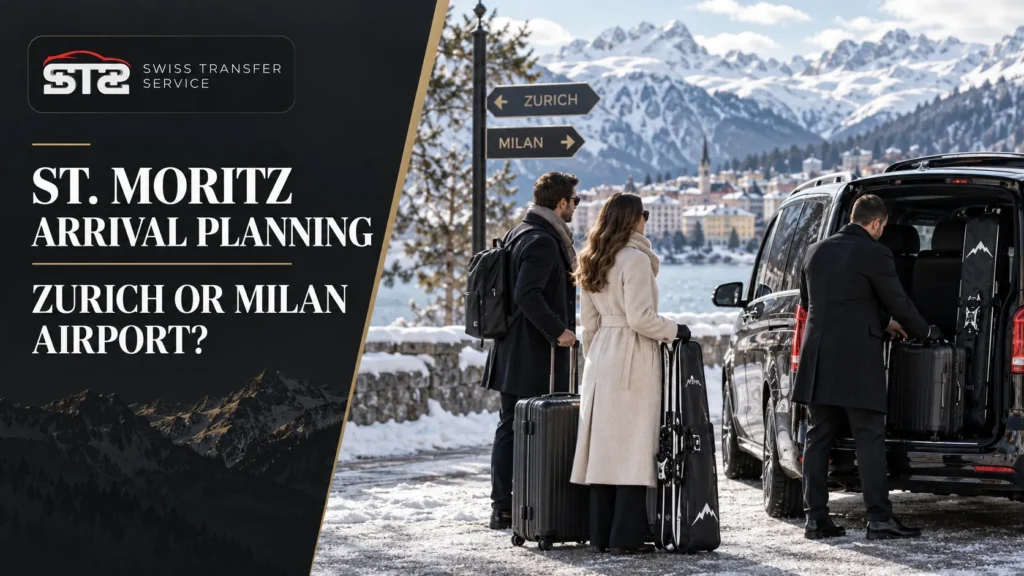
Choosing an airport for St. Moritz is not simply a question of finding the shortest distance on a map.
Zurich and Milan are both recognised international gateways for the Engadin, and official destination information describes both approaches as practical ways to reach the region.
In winter, however, the better choice depends on much more than kilometres. Your direct flight options, mountain route, rail connections, ski luggage, family or group size, border considerations and exact hotel address can all change the answer.
The useful question is therefore not:
“Which airport is closest to St. Moritz?”
It is:
“Which airport creates the simplest complete arrival journey for this particular trip?”
There Is No Single “Best” Airport for St. Moritz
Official Engadin and St. Moritz visitor information presents both Zurich and Milan as important international approaches to the region.
Milan can appear slightly closer by road on a simple distance comparison, while Zurich offers the advantage of remaining within Switzerland after airport arrival and provides a particularly strong connection into the Swiss rail network.
That means a shorter road distance does not automatically make Milan the better winter airport, just as being Switzerland’s main international hub does not automatically make Zurich the correct choice for every traveller.
Before booking the flight, compare:
- direct flight availability from your origin;
- arrival time;
- road conditions expected during your travel period;
- train practicality;
- number and size of bags;
- ski or snowboard equipment;
- children or group travel;
- your exact St. Moritz or Engadin destination.
Official destination access information is available from Engadin and St. Moritz Tourism.
Zurich Airport: When It Makes Sense
Zurich Airport is Switzerland’s principal international hub and offers a broad European and long-haul network.
Its strongest practical advantage for St. Moritz is not simply flight volume. Once you arrive at Zurich Airport, the rest of the journey remains within Switzerland.
Flight connectivity
Zurich is often a strong choice when your origin has a convenient direct flight to Switzerland.
Avoiding an additional European flight connection can matter more than saving a modest amount of road distance after landing.
This is especially relevant for travellers arriving from long-haul markets, families travelling with several bags, and executives whose priority is reducing the number of separate travel stages.
Road journey from Zurich to St. Moritz
The normal northern road approach travels toward Graubünden and continues into the Engadin through the Alpine road network.
One of the principal winter approaches uses the Julier Pass toward Silvaplana and St. Moritz.
Julier is maintained as an important year-round Engadin connection, but “year-round” should not be interpreted as “unaffected by winter”.
Snowfall, avalanche conditions, temporary road measures and chain requirements can still affect an individual journey.
Other mountain roads that may appear on summer maps are not equivalent winter alternatives. In particular, the Albula and Flüela road passes are normally closed in winter.
Vereina as a northern alternative
The northern Swiss approach also benefits from the Vereina car-transport connection between Selfranga and Sagliains.
This gives the wider northern route network an additional way into the Engadin without treating every mountain pass as interchangeable.
Current road conditions should always be checked close to travel on Engadin road conditions and the Graubünden cantonal road information service.
The train option from Zurich Airport
Zurich has a major advantage for travellers considering rail: the airport has its own railway station beneath the terminal complex.
There is no simple direct Zurich Airport to St. Moritz train that eliminates every connection. A typical journey uses the SBB network before continuing into Graubünden with the Rhaetian Railway.
Depending on the service, the journey may involve connections through Zurich, Chur or Landquart before continuing toward the Engadin.
Current connections should be checked through SBB.
For a solo traveller with light luggage, the train can be a very practical option.
The calculation changes when the journey includes children, several large suitcases or ski equipment that must be moved between trains.
Milan: When It Makes Sense
“Milan Airport” needs more explanation because Milan is served by several airports with very different flight profiles.
For St. Moritz planning, Malpensa, Linate and Bergamo should not be treated as interchangeable.
Milan Malpensa: the main international option
Malpensa is the principal long-haul airport in the Milan system and can be a strong alternative to Zurich when it offers a better direct flight from your origin.
This is particularly relevant for travellers coming from markets where Malpensa has a convenient nonstop service but Zurich would require a connection.
From northern Italy, road travel toward the Engadin can approach Switzerland through the Chiavenna and Bergell corridor before continuing over the Maloja Pass toward the Upper Engadin.
Milan Linate: useful for some European arrivals
Linate is much more focused on European and business-oriented traffic than long-haul intercontinental travel.
It can make sense when a traveller already has a convenient direct European flight to Linate and intends to continue to St. Moritz by road.
It should not, however, be treated as a direct substitute for Malpensa when comparing long-haul connectivity.
Bergamo: only if your flight actually makes it useful
Bergamo often appears near the top of “closest airport to St. Moritz” lists because of its geographic position.
That is exactly why distance-only rankings can be misleading.
Bergamo has a strong European low-cost and point-to-point profile, but it is not automatically the best international arrival gateway for every St. Moritz traveller.
If your preferred airline already flies there directly, it may be worth considering. If reaching Bergamo requires an extra connection, its shorter map distance may offer little practical advantage.
Road and border considerations from Milan
A Milan arrival introduces one element that Zurich does not: an Italy–Switzerland land-border crossing before reaching St. Moritz.
Switzerland and Italy are both within the Schengen Area, but Switzerland is not part of the EU customs union.
That distinction matters.
Schengen facilitates movement of people, but customs rules for goods still apply when entering Switzerland.
Travellers carrying goods that may require declaration should check current guidance from the Swiss Federal Office for Customs and Border Security.
Zurich vs Milan: Side-by-Side Arrival Decision
| Decision factor | Zurich | Milan |
|---|---|---|
| Direct international flights | Strong European and long-haul hub; often a good fit | Malpensa can be equally attractive depending on origin; Linate is more Europe-focused |
| Land border after arrival | No international land border before St. Moritz | Italy–Switzerland border crossing required |
| Winter road approach | Julier corridor with northern alternatives such as Vereina | Maloja corridor or other condition-dependent approaches from northern Italy |
| Rail convenience | Strong integration with SBB and RhB | Possible, but generally a more complex airport-to-St. Moritz chain |
| Ski luggage | Rail is possible, but transfers add handling | Rail generally involves more stages; road transfer may simplify the chain |
| Family or group travel | Depends on luggage, arrival time and train preference | Depends on direct flight advantage, luggage and cross-border road plan |
| Late arrival | Rail options should be checked against the actual flight | Multi-stage public transport can become less practical |
| Door-to-door requirement | Private transfer can be useful | Private transfer can be especially useful when avoiding multiple onward stages |
There is no universal winner in this table.
The strongest airport is the one that creates the simplest complete journey from your origin airport to your final Engadin address.
How Winter Changes the Comparison
Summer route maps can be misleading when planning a January or February arrival.
Zurich and the northern approach
The Julier Pass is one of the principal year-round road connections into the Upper Engadin.
By contrast, roads such as the Albula and Flüela passes should not be assumed to be available in winter.
If conditions affect the standard route, the wider northern network may involve an alternative using the Vereina car transporter.
Milan and the southern approach
The Maloja Pass provides an important southern approach between the Bergell valley and the Upper Engadin.
It is maintained as a year-round connection, but its mountain setting means weather and temporary restrictions still matter.
Other high Alpine passes shown by navigation systems should not automatically be treated as valid winter alternatives.
Live conditions matter more than a fixed travel time
Official tourism sources may provide approximate journey times from Zurich and Milan under normal conditions.
Those figures are useful for broad planning but should not become a winter arrival guarantee.
Before travelling, check:
- current road status;
- weather forecast;
- mountain-pass conditions;
- temporary chain requirements;
- accidents or road closures.
Useful live sources include Engadin road reports, Graubünden road information and current Alpine-pass information.
What About the Bernina Express from Milan?
The Bernina railway is an important part of the Milan–Engadin travel picture, but it needs to be described correctly.
The regional Rhaetian Railway services using the Bernina route and the
Bernina Express are not the same travel product.
Regional trains provide normal public transport over the route.
The Bernina Express is a panoramic tourist service with its own reservation model and timetable.
It should therefore not be presented as the default airport transfer from Malpensa or Linate to St. Moritz.
Reaching the Bernina line from a Milan airport first requires travelling through the Italian transport network toward Tirano or another suitable connection.
For someone intentionally planning a scenic rail journey, this can be attractive.
For a traveller who has just completed an international flight and wants to reach a St. Moritz hotel efficiently with winter luggage, it is a very different proposition.
The Rhaetian Railway explains the distinction between its regional services and panoramic Bernina Express product on its official information page.
Travelling with Ski Luggage
Ski travel is one of the clearest examples of why passenger count alone does not determine the best airport or transport mode.
Consider the difference between:
- two travellers with cabin luggage;
- a family with several checked bags;
- four travellers with four suitcases and several ski or snowboard bags.
The number of travellers may be similar, but the transport requirement is completely different.
Airlines apply their own sports-equipment policies, so ski and snowboard allowances should always be checked with the airline before departure.
SBB also offers luggage services that may reduce the amount of equipment passengers need to carry through railway connections.
Current information can be found on the SBB luggage services page.
If using a private transfer, provide the number and approximate size of bags and winter equipment before the journey so the vehicle category can be selected around the real luggage requirement.
Families and Groups
Solo traveller
Zurich can be particularly attractive for a solo traveller arriving during the day with light luggage because of its strong rail integration.
Milan may still be the better choice if it offers a significantly better direct flight from the traveller’s origin.
Couple travelling for a ski holiday
Either airport can work well.
Flight availability, ski equipment and arrival time often matter more than the difference in road distance.
Family with children
A journey that looks simple on a timetable may feel different with children, pushchairs, checked luggage and winter clothing.
Zurich offers the stronger rail chain, but train changes and final hotel transport still need to be considered.
Milan public transport generally requires more separate stages before reaching St. Moritz.
Family or group with ski equipment
This is where door-to-door road transport becomes easier to justify operationally.
It removes repeated luggage handling between airport, railway platforms and final local transport.
Executive or VIP traveller
For an executive traveller, direct-flight quality, privacy, final hotel access and usable travel time may matter more than the lowest theoretical road distance.
Zurich offers a relatively simple Switzerland-only onward journey.
Malpensa can still be a strong choice when it provides the better long-haul flight and the onward cross-border journey is planned in advance.
Does Your Hotel Location Change the Best Airport?
Usually, the hotel changes the final transfer requirement more than it changes the preferred airport.
St. Moritz Dorf
St. Moritz railway station is relatively convenient for the Dorf area, which can make a Zurich rail arrival particularly workable for travellers with manageable luggage.
St. Moritz Bad and Suvretta
These areas create a more obvious final-mile requirement from the railway station.
With winter luggage, assuming that the journey ends when the train reaches St. Moritz can be misleading.
Celerina and Pontresina
These destinations have their own rail connections and can work well within the RhB network.
Pontresina’s position also makes it especially relevant when planning a rail journey involving the Bernina route.
Sils, Silvaplana and Maloja
These destinations sit farther along the Upper Engadin valley and do not have the same mainline railway convenience as central St. Moritz.
For road arrivals from Italy, the southern approach through the Maloja corridor can fit naturally with destinations at this end of the valley.
Even here, however, the strength of the international flight should normally be considered before choosing the airport purely from a map.
Private chalet or address away from a station
If the final destination is not conveniently connected to the rail network, door-to-door transport becomes a more important part of the airport decision.
Train or Private Transfer?
Neither option is automatically correct.
Rail can be a strong fit when:
- you arrive through Zurich;
- your flight connects comfortably with the railway timetable;
- you travel relatively light;
- you are comfortable with train changes;
- your final destination has a convenient rail connection.
A private transfer may make more sense when:
- you have several large suitcases;
- you are carrying ski or snowboard equipment;
- you are travelling with children;
- you arrive late;
- you want to avoid multiple train connections;
- your hotel or chalet is away from a station;
- you are travelling as a group;
- privacy and door-to-door travel are priorities.
Swiss Transfer Service provides private St. Moritz transfer options for travellers who prefer a direct chauffeur journey to their final Engadin destination.
The appropriate vehicle category should be planned around the real passenger count, luggage volume and winter equipment rather than relying on a generic capacity assumption.
Practical Zurich vs Milan Decision Checklist
Before choosing your airport, answer these questions in order.
1. Which airport gives you the better direct flight?
Start with the international journey, not the final 150–200 kilometres.
2. What time will you actually land?
A daytime arrival and a late-evening arrival can produce very different rail and road options.
3. How much luggage are you carrying?
Count ski and snowboard bags separately from normal suitcases.
4. Are you comfortable changing trains?
Zurich generally provides the simpler rail option. Milan usually requires more stages before reaching St. Moritz.
5. Are you travelling with children or as a group?
Consider the complete movement of passengers and luggage, not only ticket price per person.
6. What is your exact Engadin destination?
St. Moritz Dorf, St. Moritz Bad, Pontresina, Sils and a private chalet do not create the same final-mile requirement.
7. What are the live winter conditions?
Check the actual road and mountain-pass situation close to departure.
8. If you choose Milan, have you considered the border?
Schengen simplifies movement of people, but Swiss customs rules still apply to goods entering Switzerland.
9. Do you want rail travel to be part of the experience?
If yes, Zurich and the Swiss network can be very attractive. A Bernina journey from Italy may also be worthwhile when it is intentionally planned as part of the trip rather than treated as a simple airport transfer.
10. Do you want one road journey from airport to hotel?
If so, compare private-transfer planning from the airport that gives you the stronger international flight.
Frequently Asked Questions
Which airport is best for St. Moritz?
There is no single best airport for every traveller. Zurich is often stronger for Swiss rail connections and a Switzerland-only onward journey, while Milan can be attractive when it offers a better direct flight or a convenient southern road approach. Your flight, arrival time, luggage and final Engadin destination should decide.
Is Zurich or Milan closer to St. Moritz?
Milan can be somewhat closer by road depending on the airport and route, but official Engadin guidance treats both Zurich and Milan as practical international gateways. Distance alone is not a reliable winter decision criterion.
Can I take a train from Zurich Airport to St. Moritz?
Yes, but the normal journey involves connections. Zurich Airport has its own SBB railway station, and passengers continue through the Swiss network before joining Rhaetian Railway services into the Engadin.
Can I take the Bernina Express from Milan Airport to St. Moritz?
Not as a direct airport connection. You first need to reach the Italian rail network toward Tirano. Regional RhB trains and the tourist-oriented Bernina Express are also different products, so the panoramic train should not be treated as the default Milan Airport transfer.
Is the Julier Pass open in winter?
Julier is maintained as a year-round Engadin connection, but temporary restrictions or closures can still occur because of weather or road conditions. Check live road information before travelling.
Is the Maloja Pass open in winter?
Maloja is also an important year-round connection, but winter conditions can still affect the route. Current road and weather information should be checked before departure.
What about the Albula Pass?
The Albula road pass is normally closed during winter and should not be treated as a standard winter road route to St. Moritz.
Is Milan easier for St. Moritz if I have ski equipment?
Not automatically. Milan may offer a shorter road approach in some cases, but Zurich has the easier rail integration. With substantial ski luggage, a direct road transfer from either airport can reduce repeated luggage handling.
Which Milan airport should I use for St. Moritz?
Malpensa is generally the main Milan option for long-haul and broad international connectivity. Linate can work well for certain European business routes, while Bergamo is most relevant when your preferred direct flight already uses it.
Do I pass a border when travelling from Milan to St. Moritz?
Yes. Road travel from Italy into St. Moritz crosses into Switzerland. Both countries are in Schengen, but Switzerland is outside the EU customs union, so customs requirements for goods still apply.
Is a private transfer better than the train?
It depends on the journey. Rail can be an excellent choice for a light-travelling passenger arriving through Zurich. Private transfer becomes more attractive when travellers have substantial luggage, ski equipment, children, a late arrival or a final address away from a convenient station.
Final Decision: Start with the Flight, Not the Map
The most useful St. Moritz airport strategy can be summarised in one principle:
Do not choose the airport first and solve the rest later. Compare the complete journey.
Zurich may be the better fit when:
- it offers the stronger direct flight;
- you want the simplest rail connection;
- you prefer to remain within Switzerland after landing.
Milan may be the better fit when:
- Malpensa or Linate offers a significantly better direct flight;
- you intend to continue by road;
- the southern Engadin approach works naturally with your final destination.
For both airports, winter conditions can change the practical route on the day.
If your priority is a direct airport-to-hotel journey, review the Swiss Transfer Service St. Moritz Transfer service.
To discuss a specific winter arrival, call Swiss Transfer Service on +41 76 844 05 77 or send your airport, flight, passenger and luggage information by WhatsApp.
“`